Tags
Album, CD, Home Normal, Music
My new album ‘Rusted in the Salt Air’ is out now on Home Normal.
‘Rusted in the Salt Air’ takes its title from a description of Orford Ness in WG Sebald’s ‘Rings of Saturn’ and features environmental sounds, radio waves and found objects recorded and collected on the Suffolk coast.
Field recordings include insects in the reed beds by the World War II anti-tank blocks in Minsmere, birdsong over the salt marshes and mudflats in Iken, dried-up plants rustling in the wind outside the abandoned atomic weapons research centre in Orford Ness and sea waves beside the nuclear power station at Sizewell.
Alongside these are tones from Buchla 100, Buchla 200, Serge, Erica SYNTRX and Nord Wave synthesizers and AKG BX20 spring reverb recorded at EMS (Elektronmusikstudion), Stockholm.
A massive thanks to everyone at EMS and to Ian Hawgood for mastering and releasing this.
Credits
Released by Home Normal on limited CD and download, 1 August 2025.
Environmental sounds, radio waves and found objects recorded and collected on the Suffolk coast, August 2022 and July 2023.
Buchla 100, Buchla 200, Serge, Erica SYNTRX and Nord Wave synthesizers and AKG BX20 spring reverb recorded at EMS (Elektronmusikstudion), Stockholm, October 2022 and September 2023.
Written and recorded by Wil Bolton
Cover art by Wil Bolton
Mastered by Ian Hawgood
Reviews
“Wil Bolton continues a streak of productivity, with four albums (that we are aware of!) in 2025 so far. Rusted in the Salt Air is named from a passage in W. G. Sebald’s fictionalised walking tour of Suffolk, The Rings of Saturn. The album integrates recordings and radio waves from the real East Anglia into an enthralling sonic journey at the shoreline of the listener’s mind. An interesting piece of trivia: Sebald’s journey was also retraced in Grant Gee’s film, Patience (After Sebald), with soundtrack by The Caretaker. It is hard to think of another novel that has prompted this much excellence in the ambient genre.
In Bolton’s iteration of Suffolk, short drones of electronic interference mix with birdsong. Warm, sunny loops of ambience meet with the plink-plonk of percussive droplets. At its most relaxed, the album evokes a warm day of stillness on the coast. The sea and people shift around us; the summer itself stretches out unchanging. Waves are heard lightly collapsing, while synth tones rush into the gap between each crest of water. Gently repeating melodies are gradually supplemented with additional layered phrases and textures. For a patient listener, a shoreline will continue to reveal extra layers of detail.
Bolton’s gradual melodies give each note a chance to shimmer in the sunlight. Wedded to environmental textures, melodies support a reimagining of the landscape into a soft, restful vision. At the mid-point of the album, “Heather and Gorse” gradually increases the pace of exploratory keys, whilst cerebral ambience continues overhead. The melodic details spring into bud, bloom, and decay whilst the sky and clouds remain aloof and undisturbed. Though defined by the meeting of land and sea, a coast is hardly complete without the sky and its inhabitants. “Under an Azure Sky” illuminates a cacophony of gull calls with bright beams of ambience. Gently shifting phrases of percussion evoke the masts of sailboats knocking in the breeze of a harbour.
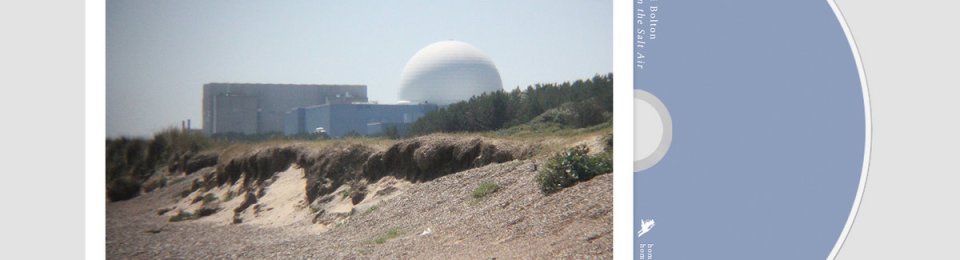
Published in 1995, Sebald’s text is the same age as the Sizewell B nuclear reactor, housed in the memorable white dome of Bolton’s album cover. Shown an aerial picture of the Dome of the Rock in Jerusalem, Sebald is reminded of “the dome of the new Sizewell reactor, which can be seen on moonlit nights shining like a shrine far across the land and sea” (Chapter 9). For very different reasons, both domes are contested spaces. The construction of Sizewell B was protested in the 1980s and 1990s, as plans for Sizewell C’s new reactors are today. One concern is environmental impact, including on avian biodiversity.
As we flock to the seaside, we holidaymakers may overlook the industrial. Bolton, however, is an attentive listener. “Ghost Signals” hears a phantom visitation, footsteps through shallow water to the backdrop of a distant alarm. The centrepiece of the album, “Reactor Dome Haze”, begins with a repeated whoosh of intensity that segues into a drone. This pattern suggests the noises of machinery and the generation of power. It also brings to mind the bright glimmer of sunlight hitting the dome.
At the close of the album, the thud and crackle of a coastal path leads us back into birdsong. Brightly pulsing ribbons of sky-blue tones somehow carry dark clouds behind them. In moments of reflection and pause, it helps to have a few more serious notes for the mind to chew over. The resurgence of birdsong offers expert counsel, as a coastline beyond human understanding retreats from view.” – A Closer Listen
“For the front cover of his fifth solo album for Home Normal, Wil Bolton’s opted for something a little more unsettling than the usual kind of bucolic imagery favoured by ambient practitioners. Shot by Bolton, the grainy photo shows a building structure on the left and on the right the upper part of a dome, its distinctive shape initially suggesting it could be an observatory. However, upon learning that the recording merges synthesizers (Buchla, Nord Wave) with “environmental sounds, radio waves, and found objects” collected by him along the Suffolk coast, the interpretation shifts as the locale is home to a nuclear power station, specifically the Sizewell B nuclear reactor. That one of the seven track titles is “Reactor Dome Haze” would seem to lend further weight to that interpretation.
Such a cover choice adds a provocative extra dimension to the project when the building of a nuclear reactor engenders understandable concerns about its impact on the environment and the potential threat it poses to human beings and wildlife. Adding to the thought-provoking nature of the release, Bolton himself clarifies that its title, Rusted in the Salt Air, comes from a description of Orford Ness in W. G. Sebald’s The Rings of Saturn; it’s thus possible to regard the album as an ambient-soundscaping analogue to the late author’s own engrossing reflection on memory, landscape, and history.
Par for the Home Normal course, the package’s inner sleeve includes details about production, gear, and track titles but nothing more, so it’s possible for a listener to hear the material without knowing anything about its background. Yet even if Rusted in the Salt Air were to be experienced in that purely music-centric way, it would still be engrossing. After all, Bolton’s a producer whose sensibility and skill-set have developed across many years, and his blending of instrument timbres with field recordings and found sounds is always artful and deft.
Coming to the listen with that context does, however, enhance one’s appreciation for the album and imbues its musical constructions with greater meaning and resonance. When fuzzy electrical drones merge with birdcalls during the opening seconds of “The Reed Beds Shimmered,” for example, it registers as something more than an arresting effect with that background factored in. During “Longshore Drift,” the focus shifts to sounds of waves gently crashing, though the droning pulse of electrical noise is never far away. Woven into the mix are melodic fragments and warbling synth textures, their presence adding significantly to the density of Bolton’s productions. Not surprisingly, the sound design alters again for “Ghost Signals,” with grainy transmissions entwining to lulling effect. Its character carries over into “Reactor Dome Haze” when repeated whooshes hint at the nightmarish scenario of machine breakdown and meltdown. “Under an Azure Sky” reinstates an aura of postcard-like splendour when sea gulls cry amidst long sweeping synth washes; even here, however, traces of electrical drones gradually force their way into the mix.
Rusted in the Salt Air fascinates for the omnipresent tension between the calming musical elements and the unease generated by the industrial dimension. A parallel to the experience of listening to the album might be the peacefulness of a summer afternoon at the beach darkened by the presence of a nearby nuclear complex. Having consumed this collection, Bolton admirers will be excited to know that Home Normal already has two follow-up volumes to Rusted in the Salt Air in the pipeline, with Concrete Botany and Barbican set for respective release next February and May.” – Textura
“Les field recordings se meuvent à l’intérieur de mélodies nées de Buchla et de synthétiseurs, mariant leur organicité à la beauté suspendue d’atmosphères au temps ralenti.
Wil Bolton nous entraine dans un voyage spatial, où les sonorités se dissolvent pour renaitre en gouttes d’eau échappées d’un univers façonné par la main d’entités aux origines inconnues.
Rusted in The Salt Air répand ses nappes, sur des lits de sable salé, libérant au contact de l’air, des fragrances electronica aux effluves ambient.
Il n’y a qu’à fermer les yeux pour s’imaginer traverser le centre d’un monde flottant, enrobé de douceur caressante et de beauté lumineuse. Très fortement recommandé.” – Silence And Sound
“Rusted in the Salt Air is a deeply atmospheric sonic journey that blends natural field recordings from the windswept Suffolk coast with lush, slow-burning electronic textures created using vintage synthesizers and spring reverb. Inspired by the haunting landscapes of Orford Ness and the literary reflections in Sebald’s Rings of Saturn, the album evokes themes of decay, memory, and transformation through immersive soundscapes rich with birdsong, wave wash, and ghostly drones.
Waves, wires, winds, and memory ::
Rusted in the Salt Air suggests an idyllic walk through the reedbed and the coastal lagoons, into the heathland and vegetated shingle. Shingle beaches are made up of different sized pebbles, and are often subject to strong winds and waves. They are constantly shifting, and this place makes a sound of its own, like no other sound. Alongside these natural field recordings are tones from Buchla 100, Buchla 200, Serge, Erica SYNTRX and Nord Wave synthesizers and AKG BX20 spring reverb recorded at EMS (Elektronmusikstudion), in Stockholm.
I hear a rich variety of interesting little things happening in a smooth warm drone of electronica and field textures. I learned that Rusted in the Salt Air takes its title from a description of Orford Ness in Winfried Georg Sebald’s Rings of Saturn, a 1995 novel that combines elements of fiction, travelogue, and memoir. The narrative follows a walking tour of Suffolk, England, where we reflect on various historical and literary themes, including the decay of civilizations and the passage of time, blending personal experiences with historical anecdotes, and explores profound themes such as memory, identity, and the impact of history on contemporary life.
The listening experience features environmental sounds, radio waves and found objects recorded and collected in the harsh coastal environment of the Suffolk coast. My intention is to use this focused listening opportunity to just sit still, resting, taking some time to listen, imagining the coastal landscape and connection to the North Sea. The mix includes the actual sound of insects in the reed beds and birdsong over the salt marshes and mudflats in Iken, dried-up plants rustling in the wind outside the abandoned atomic weapons research centre in Orford Ness, and sea waves beside the decommissioned nuclear power station at Sizewell, abandoned places on the North Sea coast, World War II anti-tank blocks in Minsmere, a home to over 5,800 different species of wildlife.
Time dissolves along the coast ::
Now we are just easing into the bog, establishing a delicate atmosphere, opening with a slow widening morning atmosphere, rich with possibilities, “The Reed Beds Shimmered” (6:08), blends with kind of an organ sound, like a church cathedral, mostly long sustained tones amidst fragments of melodies in slow motion, birds mingle within a bowed drone buzz. I swear there is a whole hidden orchestra of instruments, perhaps a marimba, creating a wonderful dark slow motion drama with birdsong that comes and goes. The tones breathe in and out slowly back and forth, the birds get the last bit. “Longshore Drift” (5:26) opens into sparse spooky electronica, the sound of the waves coming in establishes ominous dark unseen motion in the background at times, overall a long slow drone low tone spreading out into the void, through a long sustained tone, bowed and electronic layers, something is creeping along buzzing and flowing through plucked strings and warm buzzing sounds which slowly builds, restlessly and then fades into the mists.
“Ghost Signals” (3:58) brings out lots of strange night sounds out there rising and falling and rising again on and on, drones buzz in slowly, Martians call from above, the ghost is behind you right now, a low slow buzzing comes into form, I feel a perfect slow absorption into restful stillness, not dead. “Heather and Gorse” (6:12) releases more bird morning songs with those warm drones exercising and reaching upwards, sustained sparse tones, layers of colors grow lighter and rise. I love the marimba tones noodling, easy breezy, soft floating and dreamy, always keeping a slow moving chimeratic groove, now a warm rush is flowing and sustaining various instruments. I continue to return, to get lost in here.
In my inner cinema, the tension gradually grows until the crowd in the train screams as they fly past, hordes of odd little creatures signifying, or maybe just conspiring out there where we cannot see them. This “Reactor Dome Haze” (6:57) gets me buzzing and dancing a perky tempo, out of the fog and mists, textures of wood pieces tumbling, like wind or look out, there goes the scream again diving past like more rollercoaster crowd scream sounds whooshing as they pass by and again. Maybe something is trying to get in. Along comes a melodic sequencer and we release our breath like snowflakes dancing in the breeze. I hear mostly slow buzzing harmonics and electronic sounds in a slow mood. I hear the crowd screaming again and hope that they will be back.
Until the last chatter finally fades out ::
Here the gulls do not fly away, they want more. “Under an Azure Sky” (5:57) echoes with seagulls laughing, wandering tones where natural textures are fondled and explored, playful keyboard drone tones sustain, relaxing waving slowly up in the sky, calling their long sustained tones up there. You know how seagulls laugh in that collective way, until the last chatter finally fades out.
Summoning the last track, I am underwater in the near darkness, still just sitting still and resting, watching the way the light changes and flickers sometimes. We are definitely underwater but nicely illuminated. “Samphire and Sea Lavender” (8:25) settles the slow back and forth of the vision of the deep runs constantly. Things come and go, this will wash over and smooth the way to sleepytown. Some more of those birds are making strange noises, giggling and calling, moving slowly through the deep, I hear different kinds of underwater birds chanting and singing. Everything is coming to a stop as the strings slowly emerge with drone grooves, and those birds lightly gibbering and cooing. A rising long sustained tone takes the floor, mostly staying solid as new elements ease in and out as the song evolves as easily and soothing as underwater bird calls.” – Igloomag
 Wil Bolton